
Headache
Headaches are an extremely common complaint with a strongly disabling effect on daily functioning. According to the Dutch College of General Practitioners (NHG), more than 60% of the Dutch population suffers from headaches on a weekly basis. The NHG divides this mainly into tension-type headache (60%), migraine (15%) and other forms such as medication-overuse headache and cluster headache (2–4%).
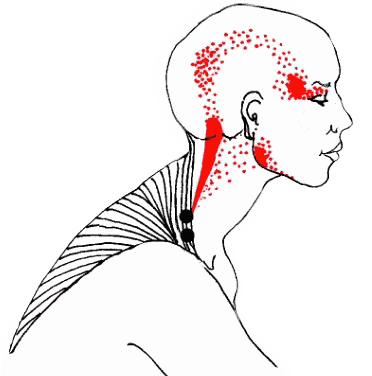
A great deal of research is carried out worldwide into the causes of the various types of headache, though with relatively little consensus and sometimes even contradictory conclusions.
For migraine, for example, it was long assumed to have a neurovascular cause – the idea being that a nerve runs too close to a dilated blood vessel, which would also explain the often pulsing or throbbing nature of migraine. However, no solid research actually supports this explanation.
Not much is known about the pathophysiology of tension-type headache. Despite the name, the NHG does not attribute the cause of tension-type headache (TTH) to muscle tension in the neck. Tension or muscle tension – along with factors like overtiredness or poor posture – can, however, trigger or worsen the headache.
Even so, many effective headache treatment methods show that headaches can indeed be regulated from the neck, and focus precisely on the movement function of the top three cervical vertebrae and on postural correction and reducing tension in the small neck muscles.
BackFysio™ combines 3 of the most effective treatment methods
1. The Watson Headache® Approach
Dr. Dean Watson PhD (Adelaide – Australia), physiotherapist/manual therapist and internationally recognised headache specialist, has spent his entire career researching migraine and headaches. He developed a specific, scientifically based treatment method for headache, tension-type headache, migraine and even cluster headache, now successfully practised in 25 countries worldwide. It is considered the most effective treatment method available for tension-type headache and migraine.
Read more about the Watson Headache® Approach
2. Dry needling
Dry needling is a method based on trigger points – specific points in a muscle where tension tends to build up and stay. Inserting an acupuncture needle into these points triggers a reflex that allows the muscle to eventually relax again.
3. McKenzie
McKenzie essentially looks at what a joint does and doesn't respond well to. If you often sit with a bent neck, for example, there's a good chance that extending a particular vertebral level can reduce the complaint.
Self-treatment is also a core principle of the McKenzie method, giving people back control over their own complaints.
Read more about McKenzie therapy
My extensive experience in treating headaches allows me to quickly recognise complaint patterns, physical characteristics and pitfalls. It's often a combination of several factors that both causes and maintains the headache or migraine – and that combination is often also where part of the solution lies. By combining the methods above, virtually all forms of headache can be effectively treated or reduced to an acceptable level.